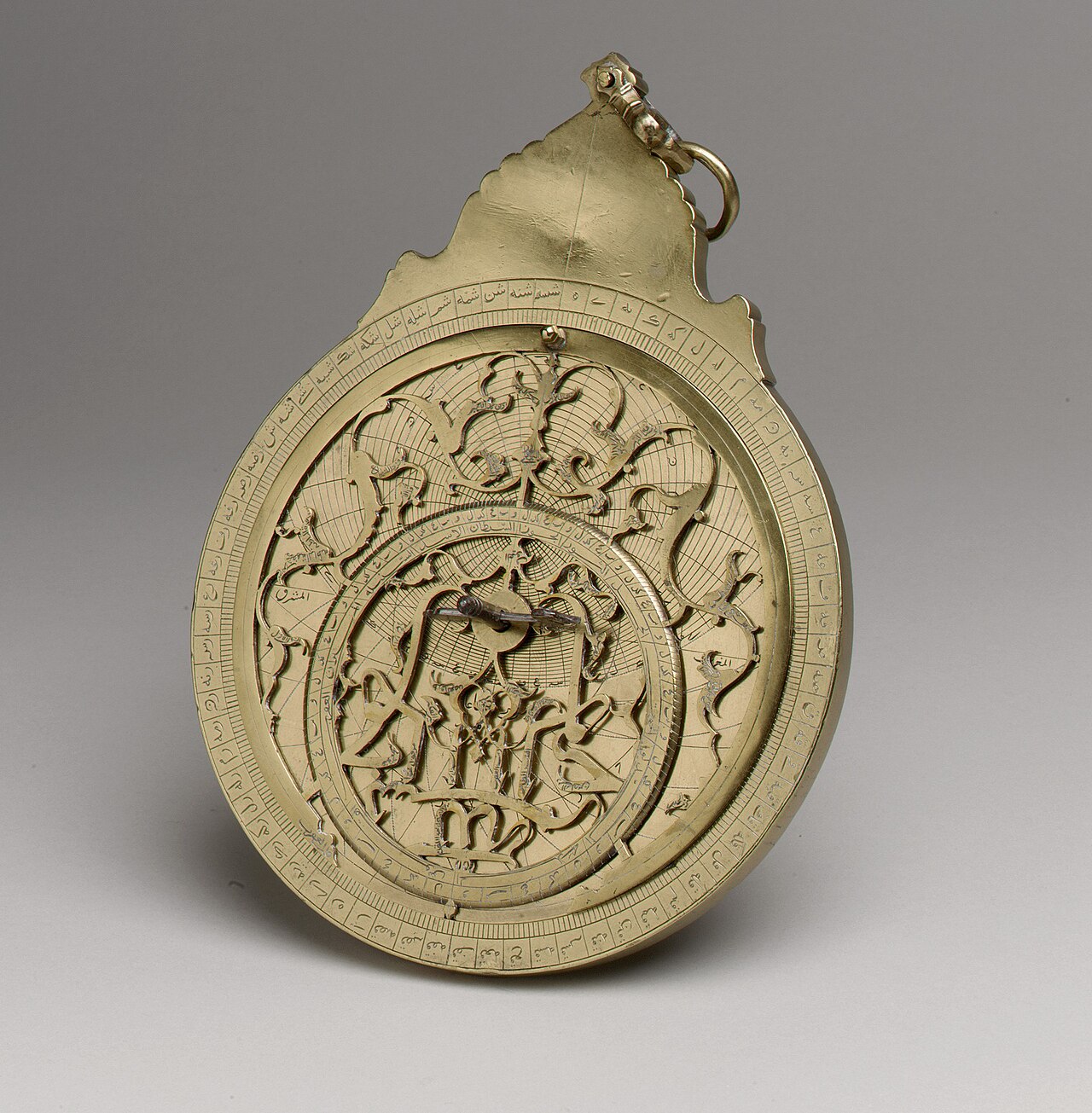
Planispheric Astrolabe
A pocket model of the sky in brass. With it an astronomer could tell the time, find the direction of Mecca and predict where a star would rise.
- Date
- AH 1065 / 1654-55 CE
- Maker
- Muhammad Zaman al-Munajjim al-Asturlabi
- Place
- South Asia, Mughal period
- Medium
- Brass
- Held by
- The Metropolitan Museum of Art
- Accession
- 63.166a-j
Entry by Your Name
This is sample content. Replace it with your own object and keep the shape.
About this object
An astrolabe is a two-dimensional map of the heavens. A rotating pointer, called a rete, shows the fixed stars over a plate engraved for the latitude where the instrument is used. Turn it to match a star’s height and the time can be read from the scale.
Looking closely
The rete is pierced into curling shapes so the plate shows through. The beauty is functional: every cut-out leaves a place for the engraved lines beneath to remain visible.
Look closer: each plate is for a place
An astrolabe usually came with several plates, each made for a different latitude. Travel far enough and you needed a different plate.
Why this object is in the collection
It joins mathematics, geography, religion and craft in one handheld object, and shows how scholars across the Islamic world refined an instrument they inherited from Greek astronomy.
Sources
- Author. Title. Publisher, Year.