A Photographic Laboratory
Milton Snow (1905-1986)
Early life
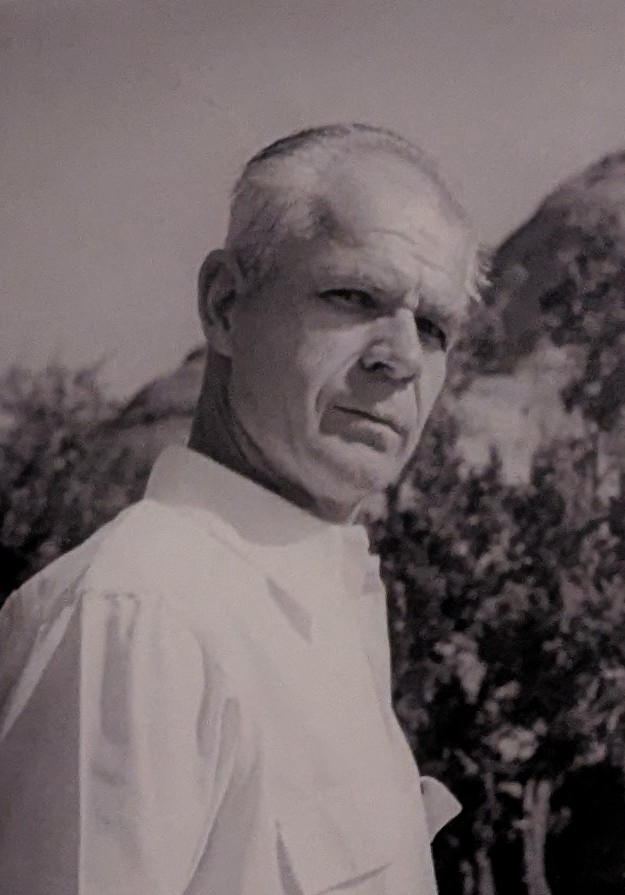
Portrait of Milton Snow (Window Rock), by Avery Edwin Field. Source: Maxwell Museum of Anthropology, courtesy of the Museum of Northern Arizona, MS315-106-3.
Milton ‘Jack’ Snow was born in Ensley, Alabama on April 9, 1905, to Maude May Acuff and Joseph Willis Snow. After his family moved to southern California when he was a child, Snow attended Riverside Polytechnic High School where he was introduced to photography. Snow had a speech impediment alongside difficulty with activities requiring fine motor control.
Snow’s dedication to honing his skills with a camera eventually led him to work for the Van Bergen-Los Angeles County Museum where he photographed archeological excavations. Over the course of twenty years, from 1937 to 1957, Snow produced thousands of images of Diné people, homes, and landscapes.
His older sister reported that Snow ‘…was a demon for self-discipline: shaved with a straight razor in the dark to develop control. Honestly … (my brother) was a perfectionist.’
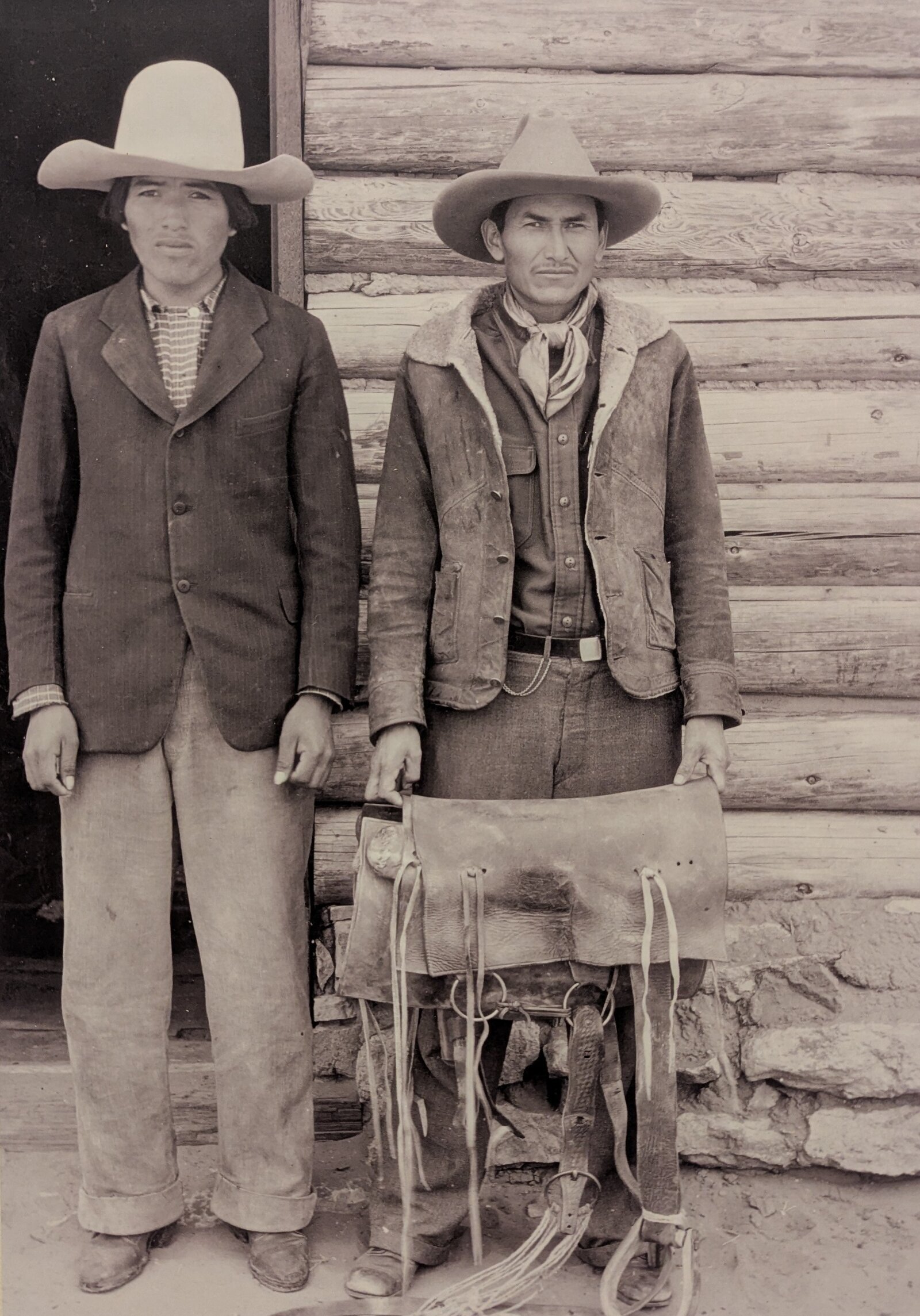
A portrait of Big Belly’s nephew and Dannie Bia with old-style saddle. Red Lake (Tolani Lakes, Leupp, AZ), 1935-1936. Source: Maxwell Museum of Anthropology Archives 87.45.268
All were intended to provide proof that federal technologies were in fact working to “rehabilitate” Navajo lands and lives. Instead, Snow’s photographs demonstrate the aftermath of the immense harm inflicted on Diné communities during this period.
Despite their origins as instruments of assimilationist propaganda, today the images serve as a rich repository of history and culture for the Diné, who remember when sheep, goats, and horses were the bedrock of a thriving economy.
Thousands of his pictures show Diné looking straight at the camera lens, standing in marked contrast to more commonly seen historic images of Indigenous people in which they clearly did not want to be photographed.
-
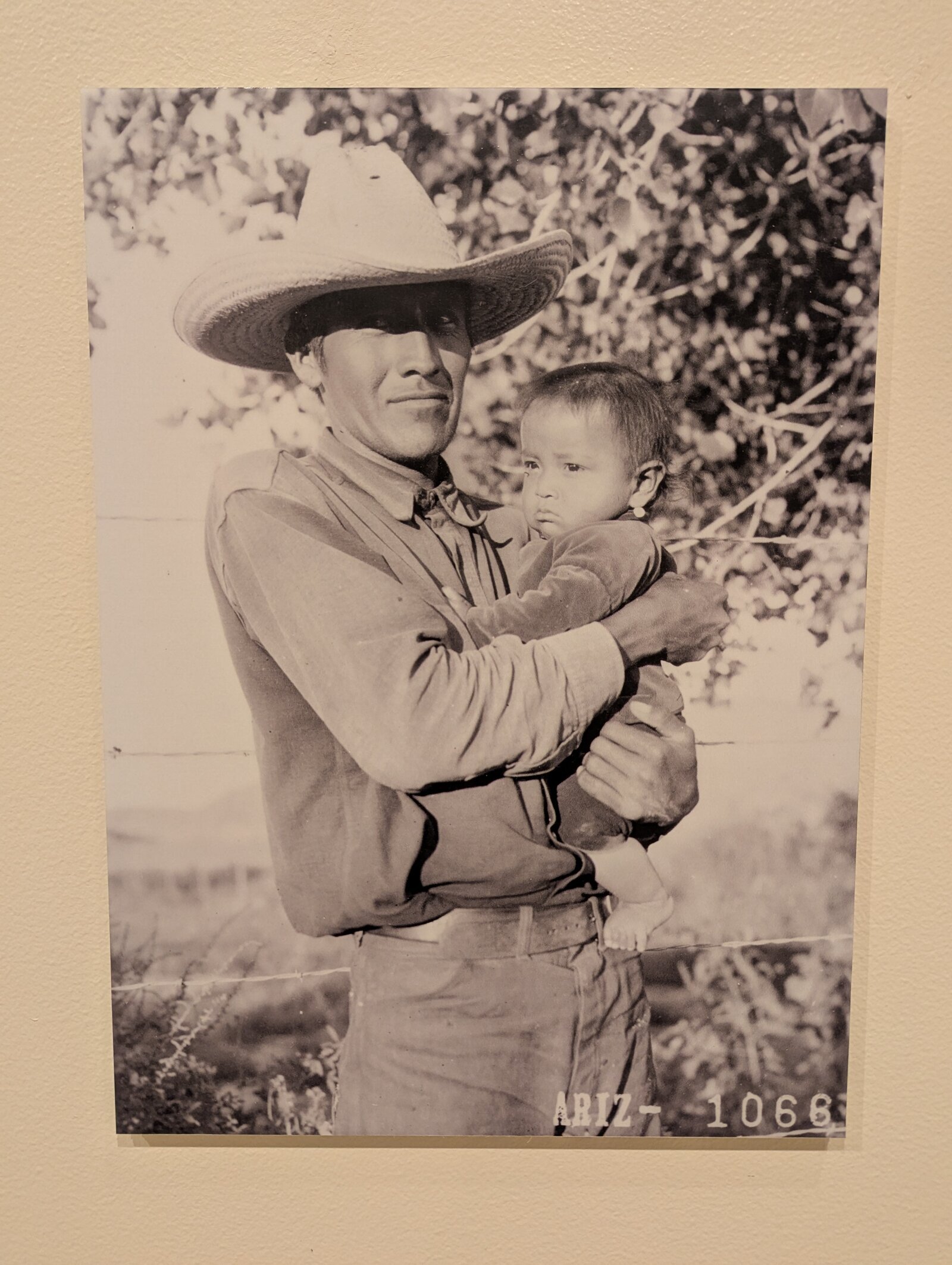
Navajo man and his baby at Tosa Nos Pos, sic (Teec Nos Pos), AZ, 1935 -
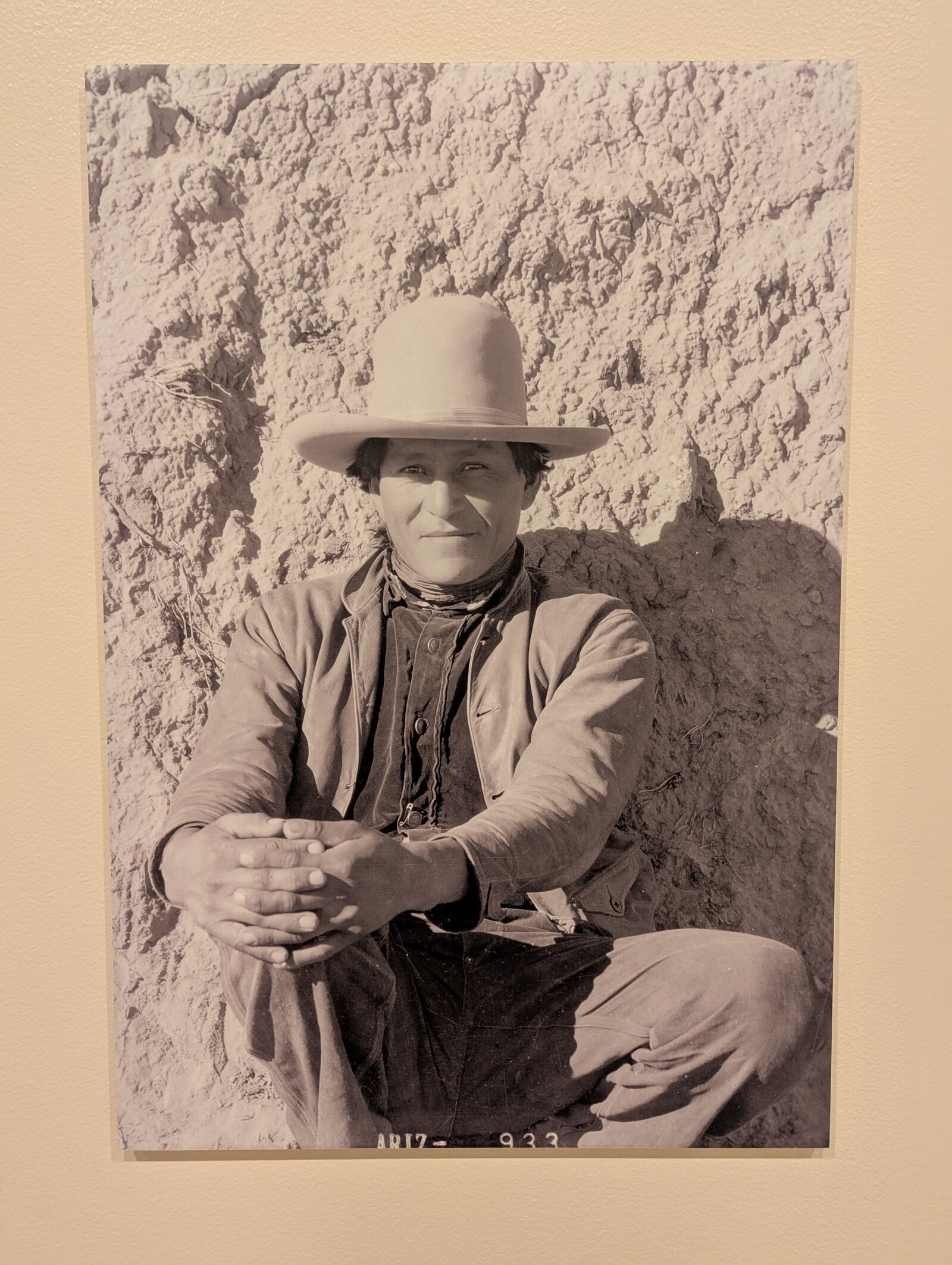
Everett McCabe. Red Lake (Tolani Lakes, Leupp, AZ), 1935-1936 -
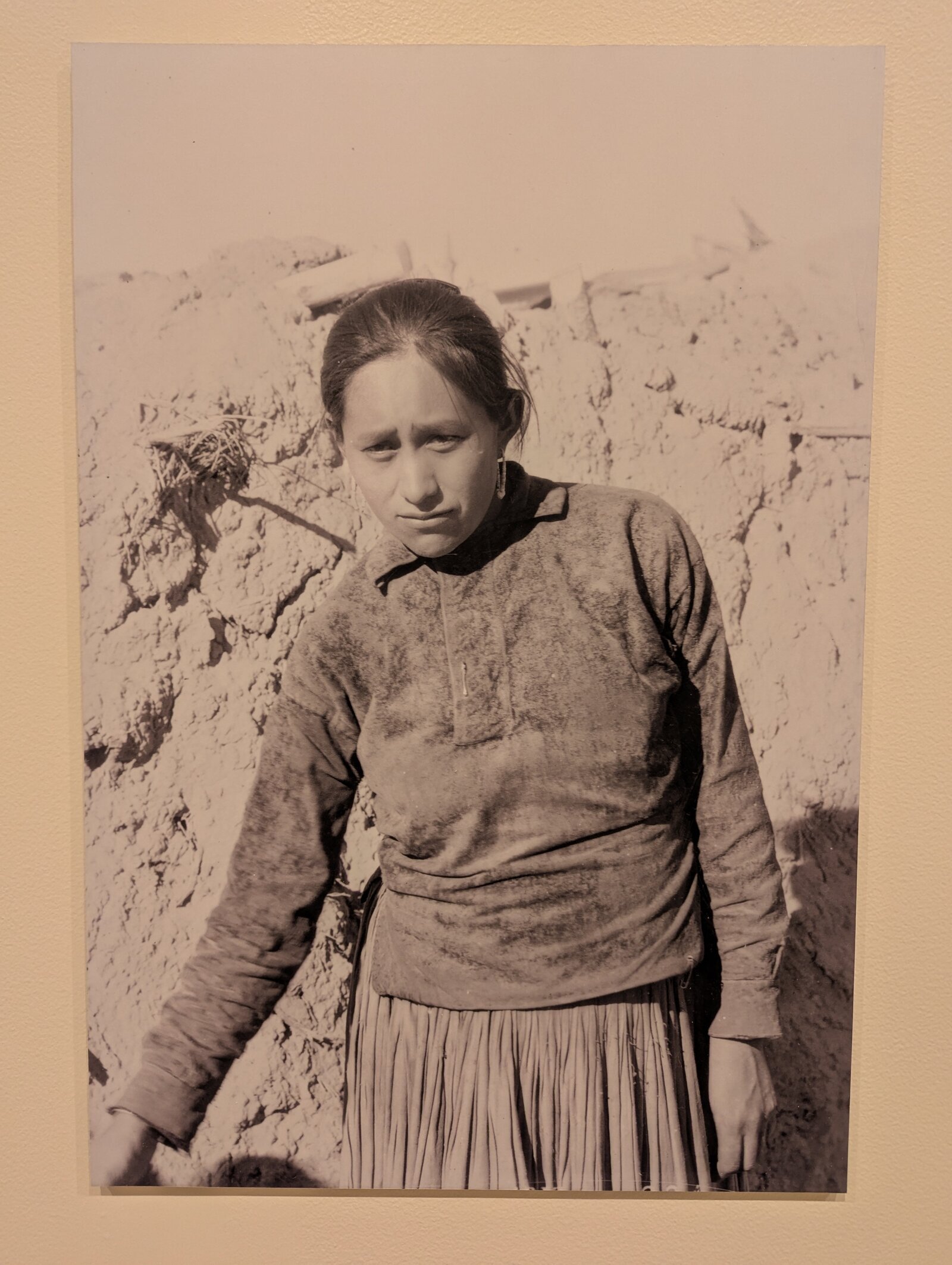
Everett McCabe's wife. Red Lake (Tolani Lakes, Leupp, AZ), 1935-1936 -
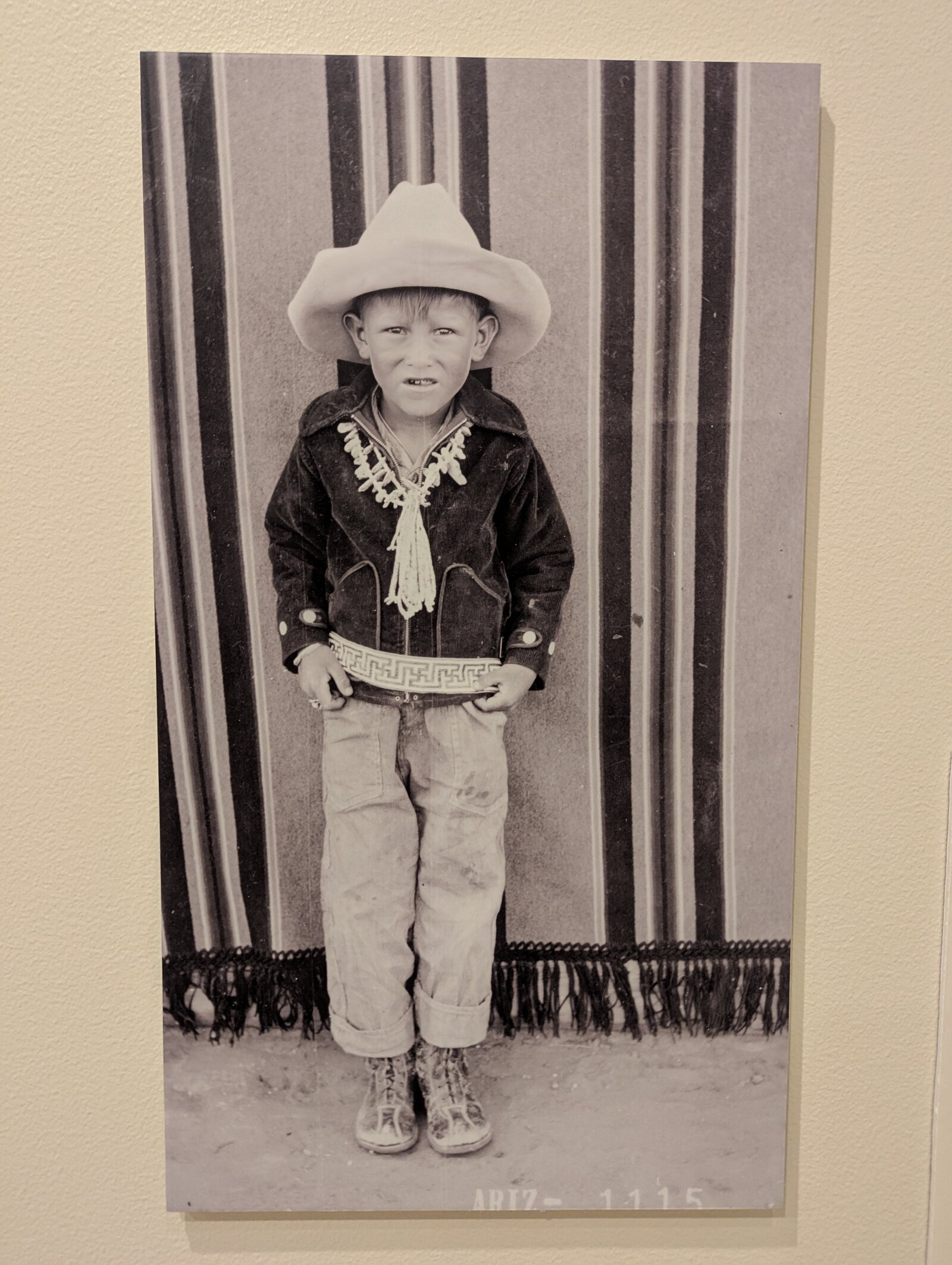
Navajo child (boy). Washington Pass (near NM and AZ border), 1935
In one photograph, Snow sits next to an elder, with his proximity suggesting that he knew the family of the elder and had taken their photographs several times.
In the convention of early American studio portraits, Snow’s photographs of individual Diné are often labeled with names and places. He was also known to give copies of the portraits to the person who sat for him.
Today, as we gaze at these beautifully rendered portraits, we are drawn to peoples’ faces, to the light reflecting in their eyes, wrinkles etched in skin, the shape of a mouth.
We examine in detail the clothing, the buttons on a suit, the American coins fastened to a woman’s velveteen collar, the schoolgirl’s blouse.
Civil Works Administration Project
In 1934, Snow was hired to work on the Civil Works Administration Project at Wupatki National Monument in Arizona as the photographer and special excavation expert. He then joined the Museum of Northern Arizona in Flagstaff to establish a photographic laboratory. While working in Gallup, New Mexico with the federal Soil Conservation Service in 1935 and 1936, Snow was hired by the Navajo Service to document the supposed improvements to life in Diné Bikeyah following livestock reduction.
People were afraid because they were interfered with and were being deprived of their only means of income - their livelihood. That’s where they got their wool to sell and their meat, where the wome[n] got their wool to weave, and so forth. They got their groceries by that [sic] means. For those reasons they did not want their sheep to be taken away. - Former tribal official Howard W. Gorman (Diné)
Portraits of a Community: K’é (Kinship)
Portraits of a Community: K'é (Kinship)
Milton Snow’s photographs are unique for the era in which they were made because they suggest that he had positive relationships with his subjects. While we don’t know much about what Snow thought of his Diné subjects, it’s often remarked that he appeared to be accepted by Diné and that he took photographs in an ethical and responsible manner.
Tug-o-War, at the fourth of July celebration, Steamboat Canyon, AZ, 1935 Source: Maxwell Museum of Anthropology Archives, 87.45.348
We imagine Navajo life in the early nineteenth century and think of our ancestors, our grandparents and our parents.
And we are reminded that the foundation of Diné life, despite and against John Collier’s plans to remake Diné into images of American citizens, is the concept of K’é, relationships of how we treat each other with respect, love, and compassion. K’é, as the foundation of the Navajo Nation, extends to Mother Earth and Father Sky and to all beings. K’é endures and we extend kinship and remember through visual images such as Snow’s.
Landscape, Community, and Home
For Diné people, knowledge of self and community is rooted in a distinctive sense of place.
Place-making is an active cultural and political activity-landscapes both hold and generate identities, memories, stories, histories, and knowledge systems. Diné Bikeyah, the land between the four sacred mountains, is the foundation of Diné life and teachings.
Hung to Dry (Hunter’s Point, AZ), 2017
Rapheal Begay (Diné)
Archival inkjet print
Courtesy of the artist
This image is one of many fond memories I have of my family’s homestead in Tse Nashchii’(Hunter’s Point, Arizona). Upon showing up late to the sheep butchering, I ventured out the backdoor of my grandmother’s home and came across this scene of hanging ak’ah (sheep fat) on the clothesline. In this moment I was transported back to my youth when I was tasked with holding it up to the sun to dry. Now, I often wonder who will be there to hold the ak’ah as we grow older and as our ways of life continue to develop, change, and evolve.
The people moved with their sheep whenever and wherever they wished with the seasons. A homesite is not good when a family lives in the same place for too long. The vegetation is tramped on too much, and it never gets a chance to grow away. Long ago, moving with the stock from one place to another was much better than what we do now. It gave the vegetation time to grow again. - Frank Goldtooth (Diné)
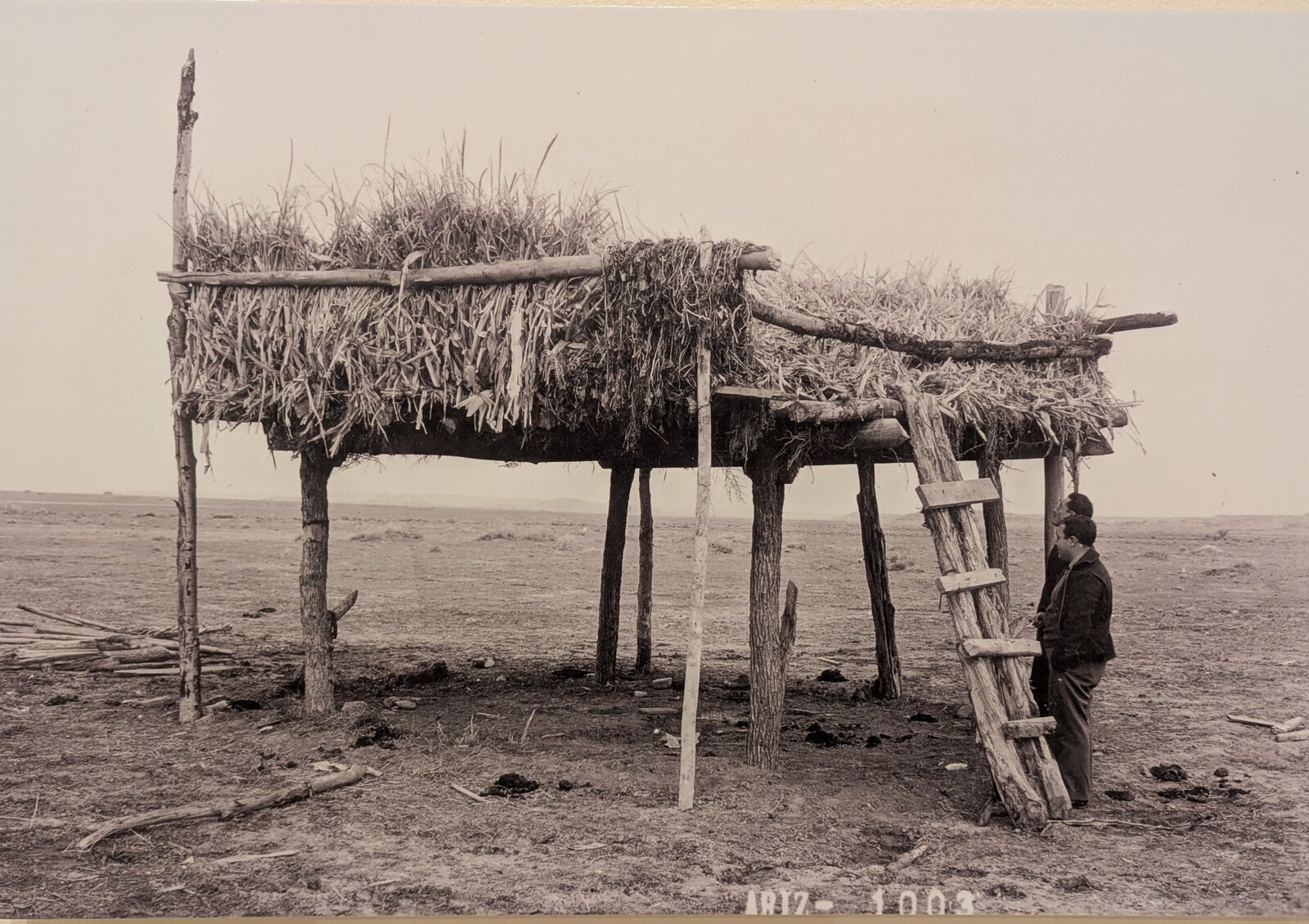
A winter sheep corral in Marsh Pass. Steamboat Canyon, AZ, 1935. Source: Maxwell Museum of Anthropology Archives, 87.45.294.
Navajo sheep have seasonal migration patterns. In the summer, sheep live in grassy highlands, and in the winters, they move down into lowlands. Sheepherders move with their sheep across the landscape over the course of their lives.
‘White Horse’s’ summer hogon on Douglas Mesa, Steamboat Canyon, AZ, 1936.
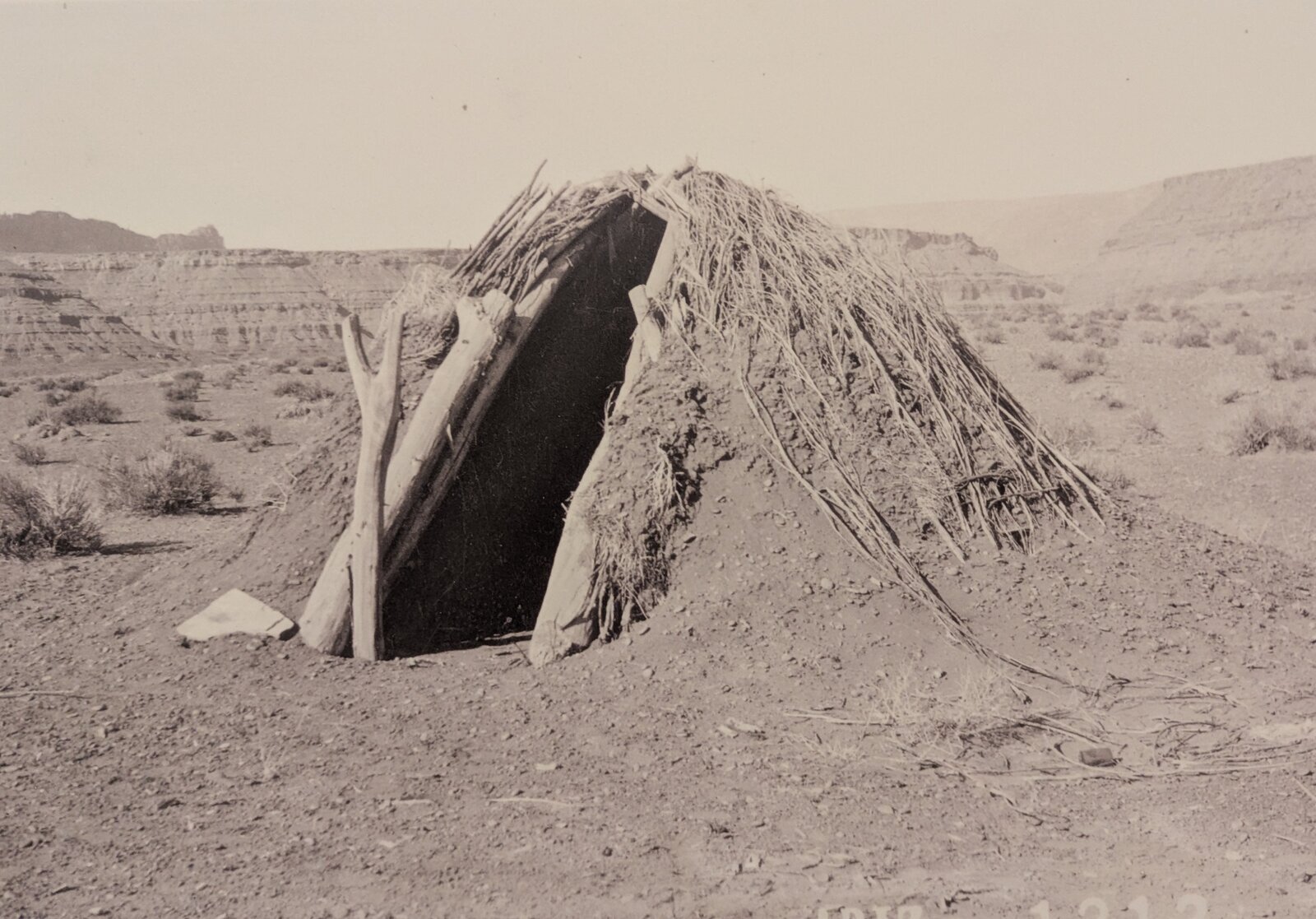
Hogan near Plute Farms, Kayenta, AZ, 1936. Source: Maxwell Museum of Anthropology Archives, 87.45.135.
The word “hogan” is English for, “hooghan,” the Diné word for “home.” Hooghan is a microcosm of the world; the world begins in the home. Across time and seasons, there are various types of hooghan that suit the climate. There also gender-specific hooghans; a female hooghan is made of earth and rounded, while a fork stick hooghan is male.
Livestock organized life. Extended kin networks followed sheep to grazing pastures across the seasons. Ceremonial cycles of songs and prayers included blessings for livestock and connected kin to Mother Earth. Sheep, goats, and horses taught children values of hard work, integrity, love, and compassion.
The federal government’s effort to eradicate Indigenous people included the violent removal of Diné people from their homelands, after a scorch and burn campaign led to their surrender.
In the fall of 1863, Diné prisoners were forcibly sent to the Bosque Redondo reservation at Fort Sumner, New Mexico. While interned, they endured harsh living conditions for four years.
On June 1, 1868, Diné leaders successfully negotiated their peoples’ return to Diné Bikeyah, realizing the People’s fervent dream to return to their homeland. We call this experience Hweeldi.
With the Treaty of 1868 signed, the People came home to a much-reduced land base. Despite this, they returned to their former home places, including those beyond the designated treaty land boundaries, and once again took up livestock raising.